
The Modern Office Space Dilemma
Square footage in modern commercial real estate is expensive, and it often goes to waste. Walk through almost any corporate headquarters, tech hub, or local business office, and you will see the same scene. A massive, beautiful conference room sitting completely empty for eighty percent of the workweek.
It is a ghost town until a major board meeting or a company-wide presentation occurs. Meanwhile, project teams, sales groups, and managers are scrambling to find quiet spaces for small huddles, client Zoom calls, or private strategy sessions.
The open-concept office footprint was supposed to foster collaboration, but it created an entirely new set of problems, primarily the destruction of speech privacy and focus. Employees need quiet environments to handle deep, analytical tasks. When small teams are forced to use massive boardrooms just to get a bit of isolation, your floor plan is actively working against your operational efficiency.
Rethinking how you utilize existing architectural footprints is the fastest way to regain lost utility without signing a lease on additional square footage. Building permanent drywall partitions is rarely the answer. Static walls are expensive to construct, require complex municipal building permits, disrupt HVAC balance, and permanently lock you into a rigid floor plan that might not fit your company’s needs next year.
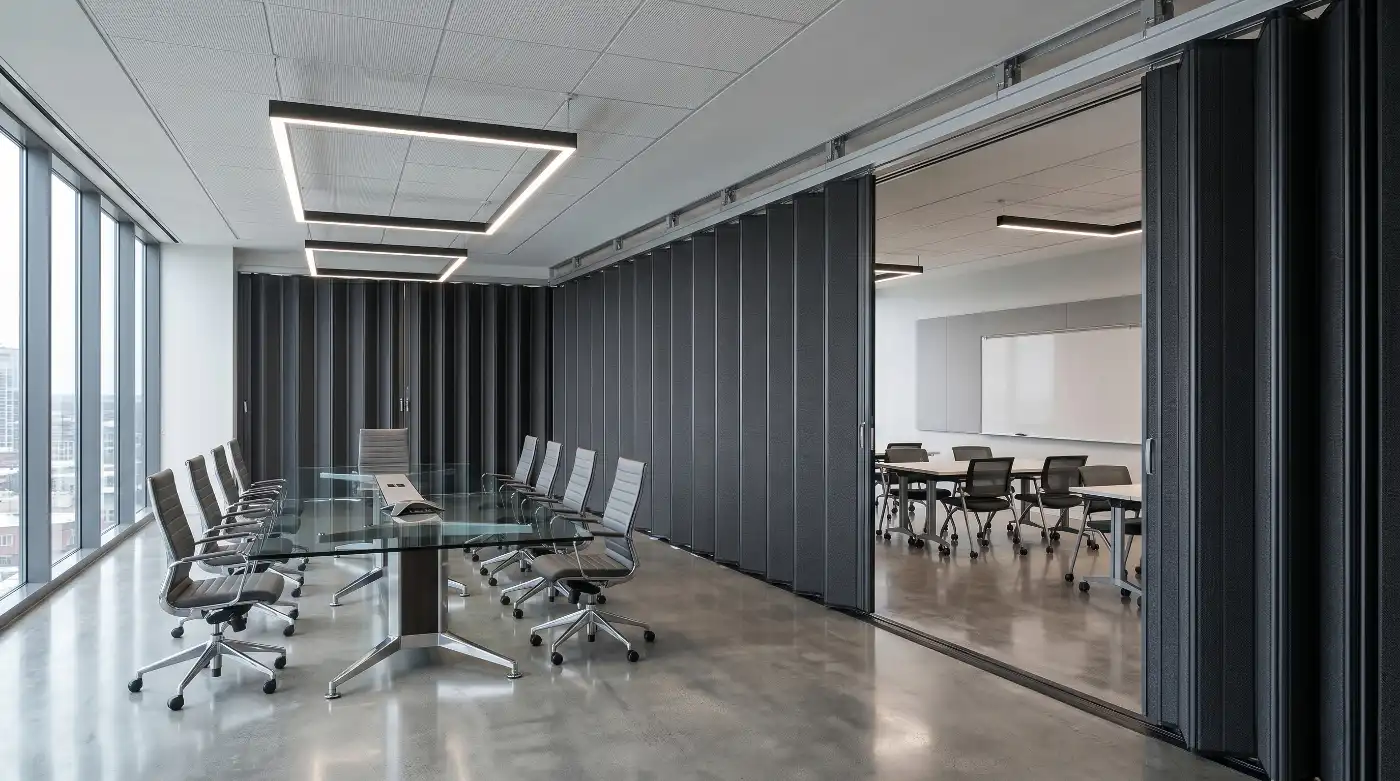
Forward-thinking facilities managers, business owners, and corporate architects are leaning heavily into adaptable layout systems. Dynamic division is the goal. By installing commercial-grade acoustic barriers, an organization can instantly transition an expansive, underutilized boardroom into two highly functional, private breakout rooms with the slide of a single panel wall.
Sound Isolation vs. Spatial Flexibility
When managing an office floor plan, the real challenge is not simply dividing a room; it is controlling the sound waves that pass through that division. Anyone can hang a basic curtain or slide a lightweight plastic screen across an opening to block line of sight.
However, visual privacy is only half the battle. If a human resource manager can hear a sales pitch occurring right next door, or if confidential financial forecasting discussions bleed into a communal hallway, the partition has failed entirely.
True acoustic division requires structures dense enough to absorb, damp, and deflect acoustic energy. Sound behaves like water. It searches for any micro-fissure, unsealed joint, or hollow gap to pour through.
A traditional door panel system without dedicated mechanical seals will allow acoustic leaks that ruin confidential operations. This balance between physical mobility and acoustic deadening is where many commercial products fall short.
To ensure your flexible layout actually functions as intended, you have to look closely at sound testing metrics. The standard benchmark for measuring sound transmission in the building industry is the Sound Transmission Class, commonly referred to as STC. According to architectural design standards maintained by organizations like the Acoustical Society of America, an STC rating represents how many decibels of airborne noise a building component can successfully block.
A higher rating means a quieter space next door. For a busy workplace, achieving an STC rating in the mid-to-high thirties is the sweet spot for turning an open zone into an isolated, confidential workspace where normal speech becomes entirely inaudible through the partition wall.
The Industrial Blueprint of the Hufcor 4100 Acoustic Accordion Door
When it comes to matching high-tier sound damping with smooth, single-handed operation, few systems match the engineering profile of the Hufcor 4100 Acoustic Accordion Door. This system is designed specifically to handle the grueling demands of high-use commercial, educational, and religious spaces while maintaining an impressive level of sound isolation.
The hidden mechanics of the Hufcor 4100 rely on a multi-layered internal design. Rather than utilizing a single solid panel, it features a dual-wall configuration supported by a heavy-duty, internal steel pantograph frame.
This internal steel skeleton ensures that the door extends and stacks in a perfectly fluid, straight line without binding or warping over years of constant operation. Attached to this frame are dual faces of laminated, dense fiberboard panels lined with specialized acoustic dampening blankets.
To isolate sound waves effectively between separate spaces, the internal architecture relies on sequential barriers that force sound to travel through multiple media. As sound leaves Room A, it first encounters an aesthetic vinyl face before passing into a dense acoustic absorption blanket.
From there, it strikes the central steel framing track, passes through a secondary mirror-image acoustic blanket, and exits through the opposite vinyl face into Room B. This multi-layered design disperses kinetic energy at every single step, ensuring a major reduction in airborne noise transmission.
This dual-wall architecture creates an internal air cavity that disrupts sound wave transmission. As airborne noise hits the outer wall, the vibration is dampened by the acoustic insulation layer and dispersed within the core cavity before it can ever vibrate the secondary wall facing the adjacent room.
The entire unit hangs from an architectural-grade aluminum overhead track system utilizing heavy-duty ball-bearing nylon wheels, allowing an employee to alter a room configuration effortlessly in less than sixty seconds.
Architectural Adaptation with Specialty Doors
Every office building features its own unique ceiling heights, load-bearing capacities, and interior design palettes. Finding a one-size-fits-all solution off a retail shelf is impossible.
The commercial division experts at Specialty Doors have built a reputation for guiding property owners through the exact mechanical specifications needed to ensure a flawless installation.
Investing in these systems requires evaluating the structural substrate above the ceiling grid. Because these high-performance partitions are top-supported to keep the floor surface completely free of dangerous trip hazards, the overhead header must be verified to handle the dead load weight of the door panels.
Working with a dedicated distributor ensures your layout is measured correctly, specified with the proper stacking parameters, and paired with the ideal track configuration for long-term reliability.
The Total System Approach: Tracking, Sealing, and Stacking
A major mistake made during office renovations is focusing exclusively on the center of the door panel while ignoring the perimeter joints. If the top, bottom, and side connections of an acoustic partition are left unsealed, noise will bypass the door entirely. The Hufcor 4100 avoids this trap through a comprehensive perimeter sealing system.
At the top of the door, heavy-duty multi-finger vinyl sweeps rub continuously against the inside of the aluminum track channel, blocking sound waves from escaping over the header. At the base, specialized soft vinyl sweep seals extend downward to hug the floor surface tightly without scratching or scarring your commercial carpeting or hard flooring.
The entire cross-section of the perimeter sealing network is engineered to isolate acoustics from top to bottom. It begins with the overhead header support anchoring the main aluminum track, where integrated multi-finger vinyl top sweeps form a labyrinth that traps escaping high-frequency sounds.
Directly below, the core panel of the Hufcor 4100 dampens the vast majority of directional sound, while durable bottom sweep seals compress securely against the finished office floor to bridge the lower gap cleanly without scraping.
To close the loop, the lead edge of the door features a full-height magnetic latching strip that pulls the partition securely into a dedicated wall jamb, sealing off lateral light and sound leaks completely.
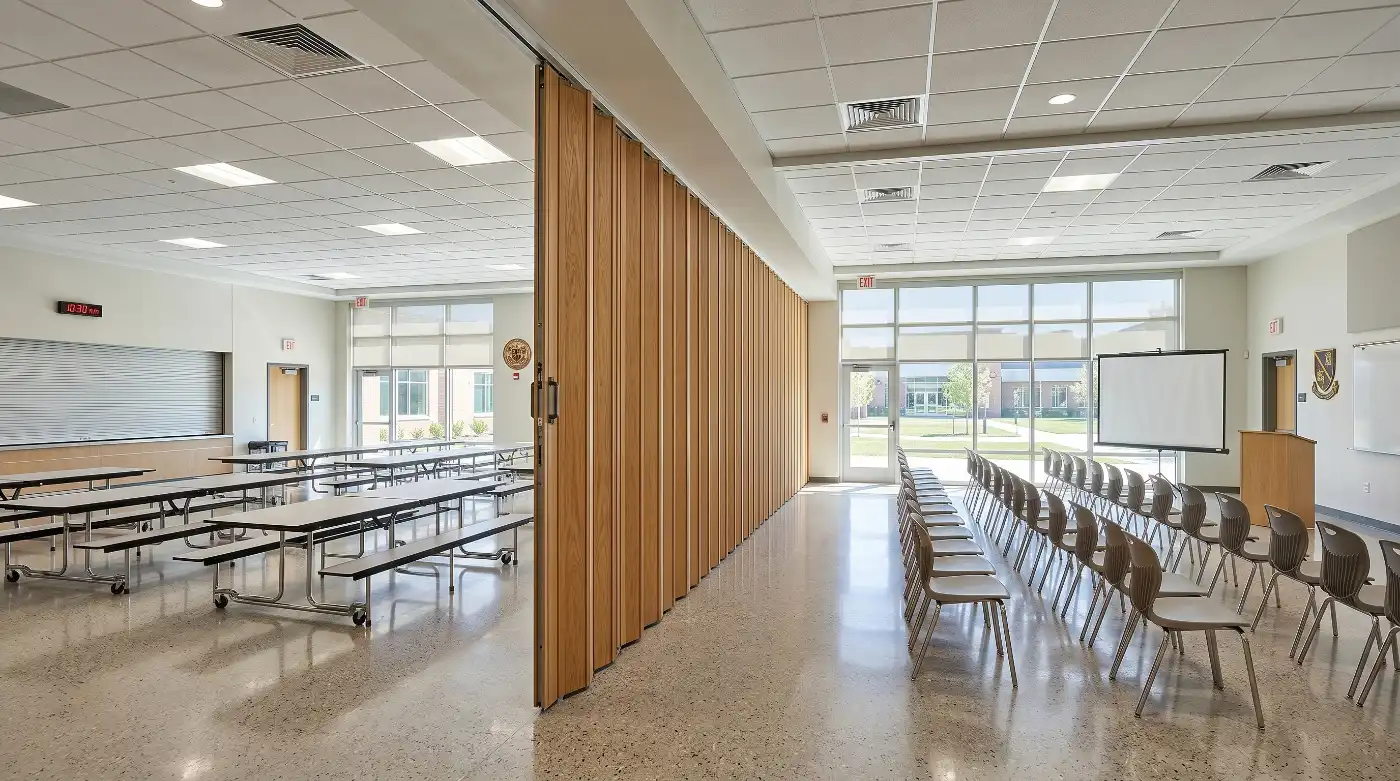
Beyond sealing mechanics, you must consider space optimization when the door is not in use. When open, the accordion panels fold compactly into a neat stack at the edge of the room, taking up minimal wall space.
This tight stacking capability ensures your conference room retains its expansive feel for large gatherings, while remaining instantly ready to deploy into segregated workspaces at a moment’s notice.
Beyond Conference Rooms: Diverse Commercial Layout Solutions
While corporate boardrooms are prime candidates for flexible acoustic walls, the need for intelligent spatial control extends across many different industries and floor plans. Different facilities require distinct configurations depending on whether their primary goal is acoustic isolation, fire safety, or physical security.
Comprehensive Spatial Division
For larger, open areas like church fellowship halls, school gymnasiums, or hotel ballrooms, traditional wall placements are far too restrictive. Utilizing customizable room dividers allows these facilities to host multiple independent events simultaneously, maximizing daily programming capacity and boosting rental revenue.
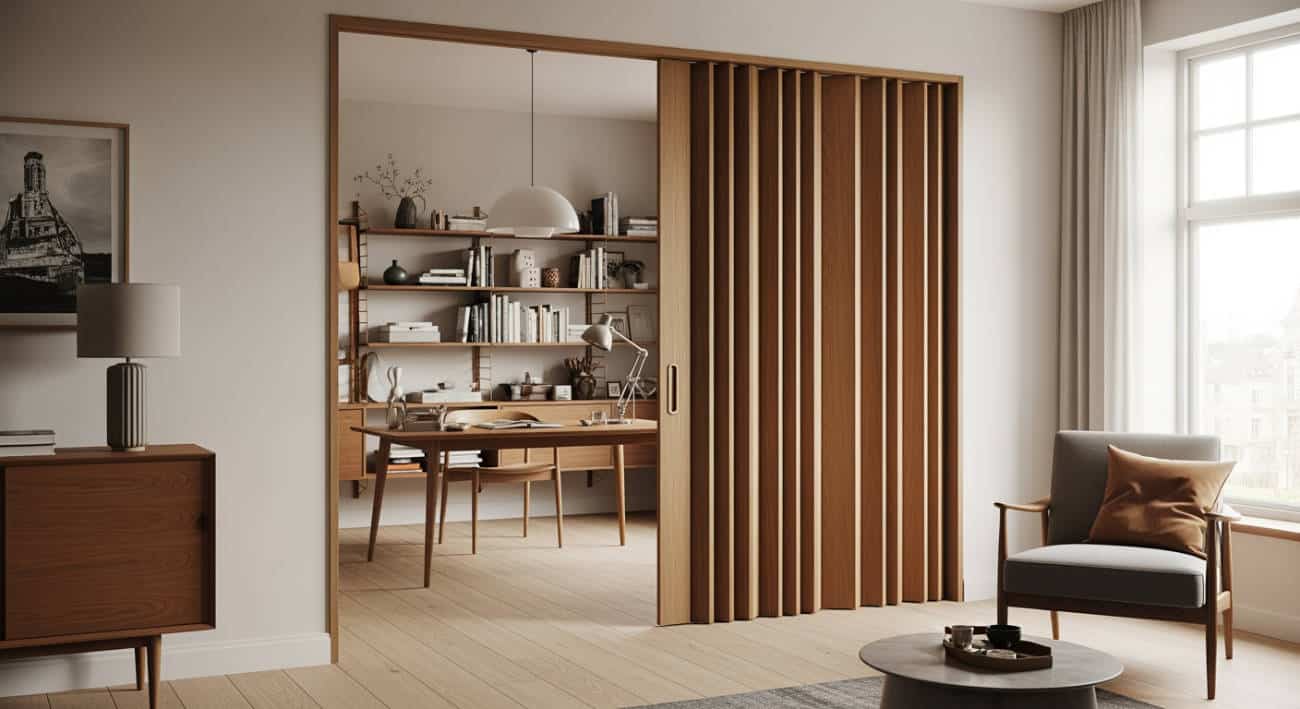
When looking for an elegant, low-profile alternative for quick visual separations, standard accordion doors offer an incredibly cost-effective way to close off storage alcoves, breakrooms, or classrooms without the swing clearance required by a traditional door.
Secure Access Controls
For retail storefronts, airport kiosks, public schools, and hospital pharmacies, the primary challenge is locking down physical access points after hours without completely blocking visibility or ventilation. Installing heavy-duty roll-up doors provides an unyielding metal barrier against forced entry while rolling up compactly out of sight into a ceiling shroud during standard operational hours.
When a facility requires a physical barrier that can navigate complex curves or radius tracks, the solution shifts to the highly adaptable Mobilflex architectural grilles.
These folding security closures are perfect for shopping mall concourses, bank teller counters, and institutional corridors because they slide laterally into shallow wall pockets, preserving clean sightlines while providing robust physical security.
To ensure your specific project needs line up with the right product classification, it helps to understand the core application matrix of commercial doors. The Hufcor 4100 series serves as the primary standard for acoustic privacy and structural wave damping in corporate and educational interiors.
For perimeter safety and vertical physical protection, industrial roll-up closures provide an unyielding barrier that blocks unauthorized after-hours access.
When your layout features unconventional geometries, lateral Mobilflex grilles step in to deliver dependable physical security along curved or radius floor tracks, while heavy industrial elephant doors are reserved for massive sound stages or aerospace facilities that must isolate massive structural openings.
For massive industrial settings, aerospace hangars, or sound stages that require dividing gargantuan openings, standard commercial panels are simply not large enough. These extreme spaces rely on specialized elephant doors, which are engineered to move massive vertical loads while providing heavy-duty acoustic and thermal insulation across immense industrial environments.
Financial Efficiency: Lowering the Total Cost of Ownership
To truly understand the value of an adjustable acoustic partition, you have to look past the initial acquisition cost and look at the long-term return on investment. According to corporate workplace spending studies published by real estate analytics groups like JLL, commercial interior fit-outs and traditional remodeling costs have risen sharply due to supply chain complexities and specialized construction labor shortages.
Opting for an operable partition wall instead of standard drywall construction lowers your total cost of ownership in several distinct ways:
-
Tax Depreciation Advantages: Permanent walls are classified as real property modifications, which must be depreciated over a lengthy 39-year timeline. Movable partitions like accordion doors are classified as tangential furniture and equipment, allowing your corporate accountant to utilize accelerated depreciation schedules for quicker tax write-offs.
-
Zero Construction Downtime: Building a permanent wall requires shutting down a section of your office for days or weeks to handle framing, drywall hanging, taping, mudding, painting, and trim work. This creates endless dust, noise, and operational disruption. An accordion partition installs cleanly onto an overhead track with zero mess and minimal downtime.
-
HVAC and Light Optimization: Permanent partitions require rearranging expensive ductwork, thermostat controls, fire sprinkler zones, and electrical lighting layouts to keep the newly created rooms code-compliant. Movable walls allow you to share existing environmental systems across zones, saving thousands in MEP engineering fees.
Step-by-Step Selection Guide for Facilities Managers
If you are tasked with upgrading your company’s conference space, navigating the exact ordering options can feel overwhelming. Following a structured assessment method ensures you choose a system that performs beautifully for years without operational hiccups.
First, determine the primary goal of the space. If confidential conversations or video calls occur regularly, don’t compromise on an unrated door panel. Ensure you request an acoustic model like the Hufcor 4100 to gain that critical STC defense layer.
Next, analyze your physical clearance and structural capacity. Measure the exact height and width of the finished opening at multiple points to account for uneven floors or settling headers.
Consult with your structural engineer or facilities team to verify that the overhead joists can support the dead weight of a heavy-duty acoustic panel system.
Finally, select your finish materials carefully. Modern acoustic doors are available in a massive selection of heavy-duty commercial vinyls, wood veneers, and woven fabrics.
If your conference room sees high traffic or serves as a multi-purpose lunchroom, selecting a durable, stain-resistant, wipeable vinyl facing ensures the door stays looking fresh and professional for years to come. For advanced ordering assistance, connecting directly through our online blog portal provides deep dives into recent case studies and product updates.
The Short Version: Acoustic Accordion Doors
-
Spatial Optimization: Operable partitions eliminate dead space by transforming underutilized boardrooms into multiple, high-occupancy breakout zones instantly.
-
Acoustic Engineering: True speech privacy relies on high STC-rated systems like the Hufcor 4100, which utilize internal steel frames, acoustic insulation blankets, and dense dual-wall paneling.
-
Perimeter Perfection: A partition’s sound isolation is only as good as its seals. Multi-finger top sweeps, bottom vinyl sweeps, and magnetic wall jambs prevent sound from leaking through gaps.
-
Strategic Security Alternatives: Beyond acoustic needs, modern spaces rely on roll-up steel closures, lateral Mobilflex grilles, and heavy industrial elephant doors to manage safety and access control.
-
Financial Advantages: Utilizing movable wall systems lowers your facility costs by reducing construction downtime, optimizing HVAC distribution, and qualifying for accelerated asset depreciation.
Transform Your Workspace Potential Today
Do not allow restrictive floor plans or distracting office noise to kill your team’s daily productivity, focus, and collaboration. Maximizing your existing square footage requires intelligent engineering, commercial-grade acoustic materials, and an absolute commitment to structural quality.
The veteran team of layout consultants at Specialty Doors is standing by to evaluate your commercial blueprints, church designs, or school floor plans, providing clear, itemized product recommendations designed to maximize your spatial utility.
Ready to bring elite sound control, smooth operations, and ultimate flexibility to your corporate environment?
Reach out directly to our application specialists today by visiting our contact us page to request your comprehensive, no-obligation product layout consultation.