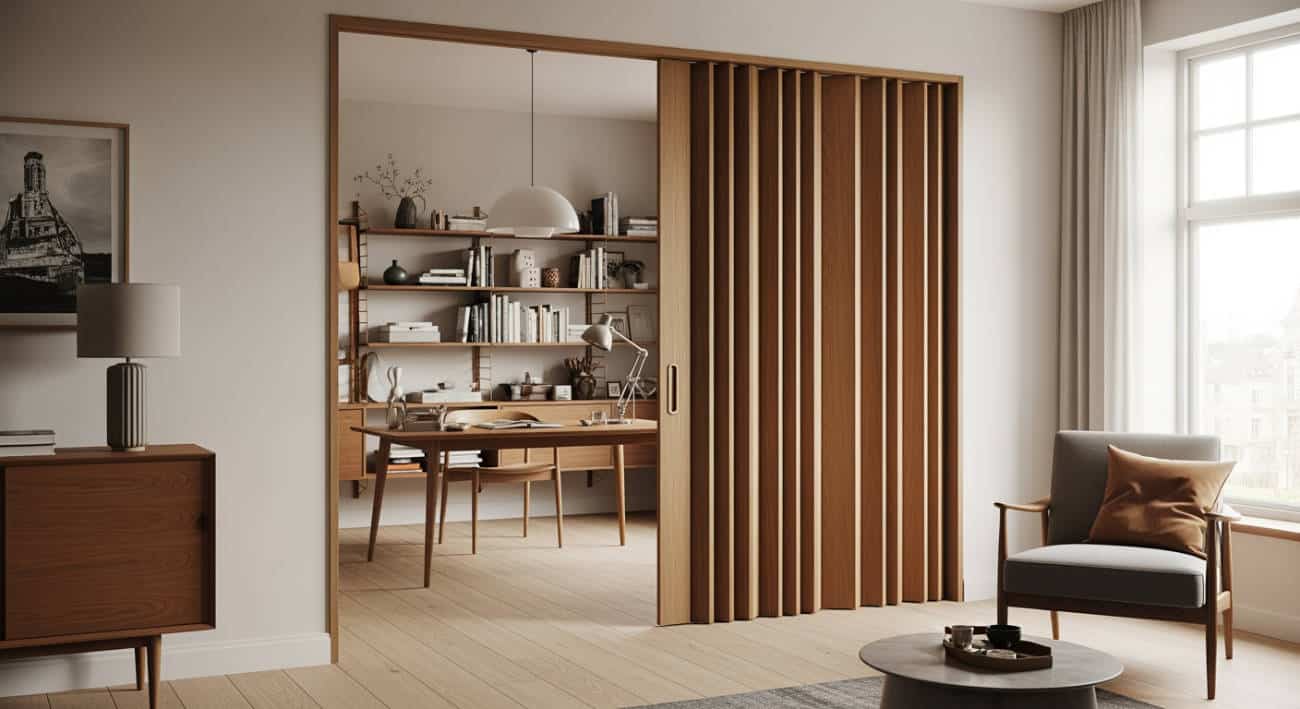

Achieving a flawless, high-end look in interior design relies heavily on the details. When you install a premium room divider or folding partition, you are adding a major architectural element to your space. If the wood tones of that new fixture clash with your existing hardwood floors, the entire room can feel visually fractured and disorganized.
Specialty Doors & Hardware provides elite access to premium architectural closures that solve complex spatial challenges. Among our most versatile offerings is the Woodfold series. These doors give property owners a functional way to divide spaces without sacrificing luxury or aesthetic value.
Creating a seamless visual flow requires strategic planning. You must understand how different wood species interact with stains, finishes, and ambient lighting. This comprehensive guide details the best methods to match your hardwood floor stains with custom Woodfold veneers to ensure perfect design cohesion.
Understanding Your Woodfold Veneer Options
The foundational step in creating a cohesive interior layout is selecting the right wood species for your folding door. Wood is a natural, dynamic material. Every species possesses unique grain patterns, baseline colorations, and structural densities that alter how it absorbs pigment.
When configuring a premium partition, selecting the right species establishes your baseline tone. The core options available allow for immense architectural flexibility.
The Distinct Traits of Hardwood Veneers
-
Oak: Known for its prominent, open grain patterns and exceptional structural durability. Oak naturally features warm undertones. It accepts a wide spectrum of stains evenly, making it highly adaptable to traditional or rustic settings.
-
Maple: Features a dense, tight, and remarkably fine grain structure. Maple carries a light, creamy natural color. Because its pores are so tight, maple can absorb stains unevenly if not prepped correctly, often looking best with clear coats or light tinting.
-
Birch: Offers a smooth, uniform texture with subtle, wavy grain patterns. Birch is a highly versatile hardwood with a pale blonde baseline. It serves as an excellent canvas for mimicking more expensive woods when stained properly.
-
Walnut: Celebrated for its deep, rich, chocolate-brown natural tones and elegant swirling grain. Walnut looks stunning with simple clear coats that highlight its natural beauty, but it can also be enriched with deep, dark finishes.
-
Mahogany: Delivers a luxurious, deep reddish-brown color profile with a straight, fine grain. Mahogany brings an immediate sense of classic sophistication and warmth to any executive or residential space.
-
Cherry: Possesses a smooth, closed grain that begins as a light pinkish-brown and darkens over time with exposure to sunlight. Cherry develops a rich, lustrous patina that coordinates beautifully with warm floor stains.
To review these specific material configurations and technical specifications, explore the options on the Specialty Doors & Hardware Woodfold 220 Product Page.
The Science of Mixing and Matching Wood Tones
Many property owners mistakenly believe they must find an identical, flawless match between their floors and their folding doors. Attempting an exact match across different manufacturing runs, wood lots, or species is incredibly difficult and often looks unnatural.
Instead of chasing an impossible duplicate, design experts focus on color harmony and intentional contrast. Your goal should be to make the relationship between your floors and your Woodfold panels look deliberate and balanced.
Identify the Dominant Undertone
Every wood floor has a distinct undertone that dictates its color family. These undertones generally fall into three categories: warm, cool, or neutral.
Warm floors feature shades of yellow, orange, red, or gold. Cool floors display undertones of gray, taupe, or weathered white. Neutral woods look slightly muted, often falling into a soft tan or beige spectrum.
To maintain cohesion, always match the undertone family of your floor to the undertone family of your Woodfold veneer. For instance, if you have warm white oak flooring with a golden stain, pairing it with a warm cherry or warm oak door panel maintains a harmonious visual flow. Mixing a strong, red-toned mahogany door with cool, gray-washed maple floors can create a harsh, conflicting aesthetic.
Follow the Rule of Two Shades
If you choose not to match the colors closely, use contrast intentionally. A great design technique is to ensure your custom veneer is at least two shades lighter or two shades darker than your hardwood floors.
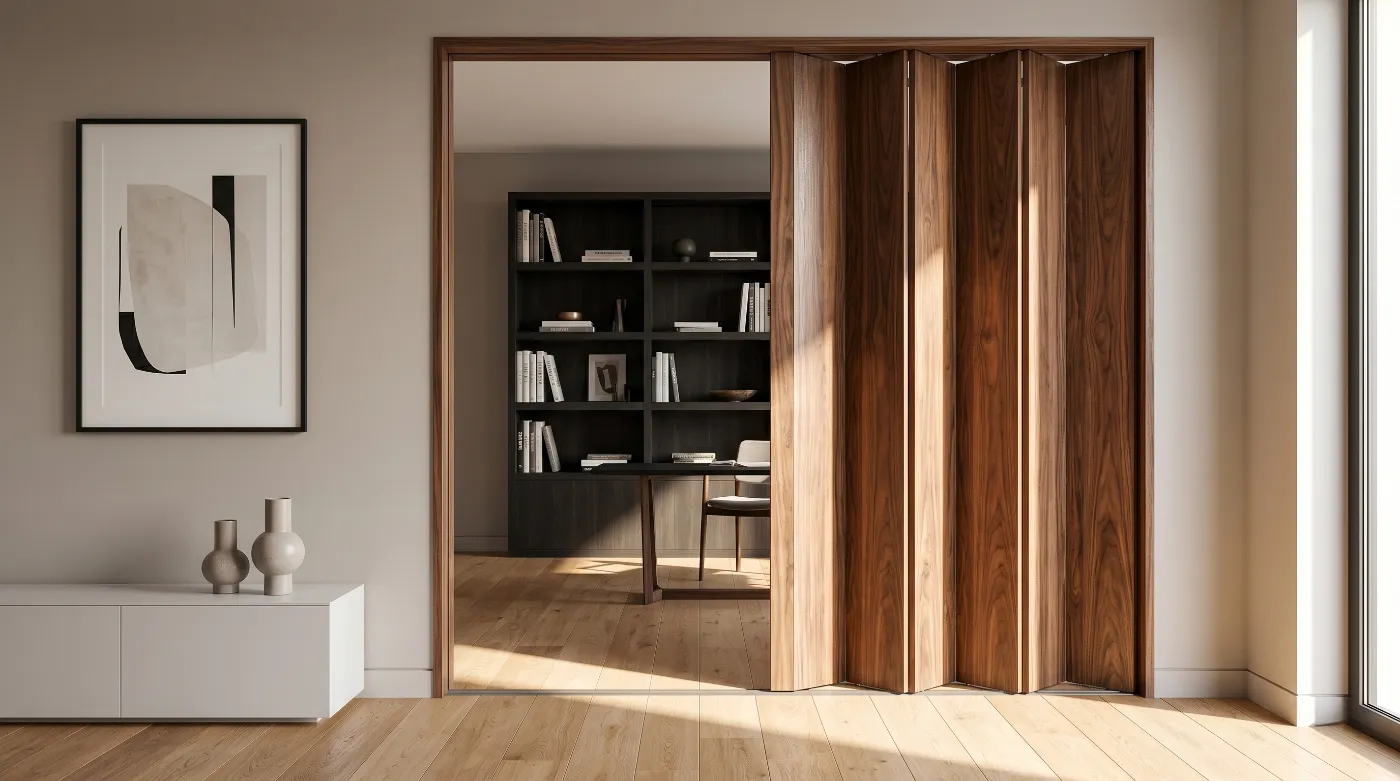
This clear difference creates a beautiful sense of depth. For example, if your home features light, natural birch flooring, installing a deep, dark walnut partition establishes a luxurious, intentional contrast that frames the room beautifully.
For professional insights into the psychology of interior color relationships and structural color forecasting, you can read the latest updates from the American Society of Interior Designers.
Selecting Closures for Unique Spatial Challenges
Dividing a room requires choosing a door style that fits your specific spatial constraints and functional goals. Different architectural layouts demand distinct closure mechanisms to maximize both usability and style.
The Utility of Accordion Doors and Room Dividers
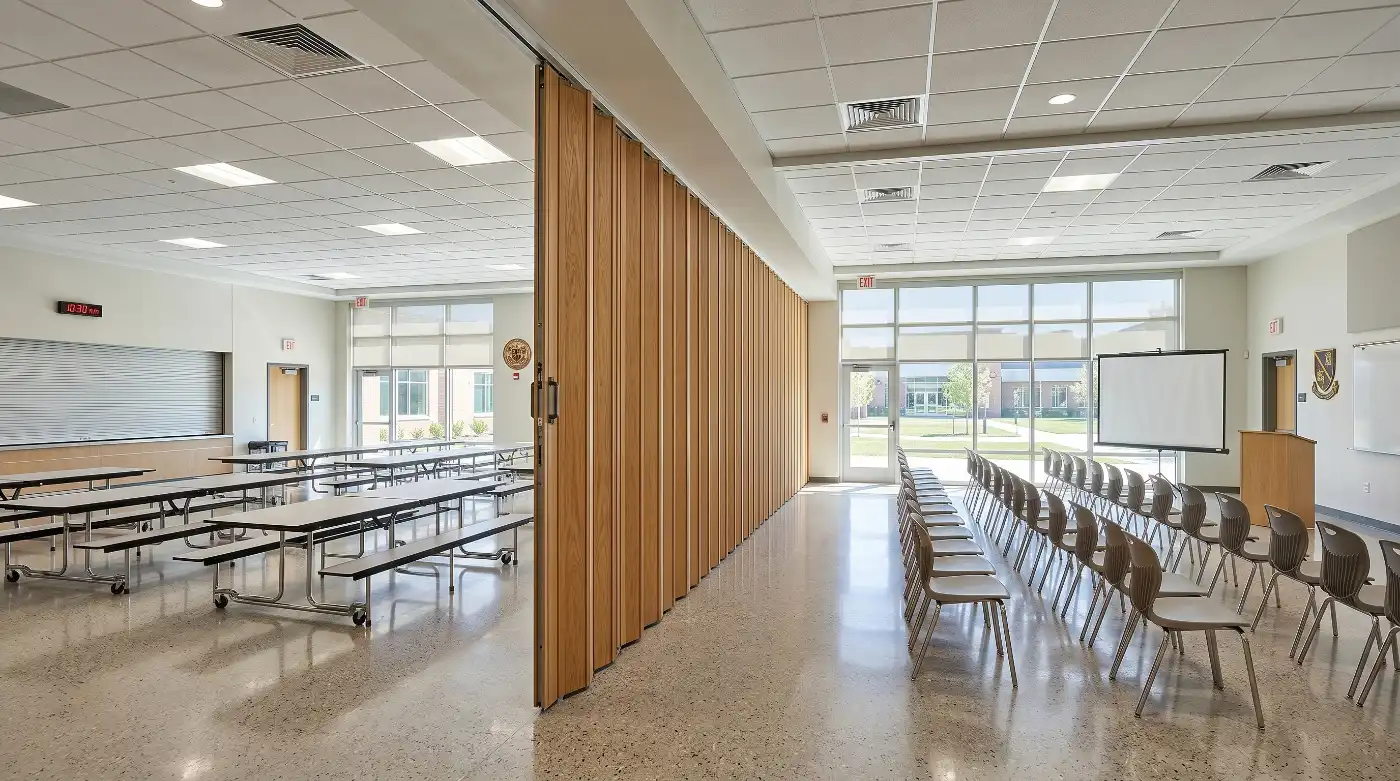
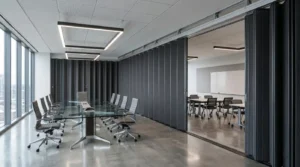
For spaces where floor area is limited, standard swinging doors are often impractical. Accordion doors solve this issue by folding compactly within their own track system. This makes them ideal for dividing large conference rooms, closing off residential home offices, or hiding utility closets.
When crafted with high-quality wood veneers, these doors act as a moving architectural wall that enhances the room’s design value. Selecting a veneer that complements your flooring ensures the room looks expansive and unified whether the partition is open or closed.
To view our complete line of flexible space-saving solutions, browse the Specialty Doors & Hardware Accordion Doors Page and check out the options on our Specialty Doors & Hardware Room Dividers Page.
Advanced Industrial and Commercial Closures
Commercial and industrial spaces often require heavy-duty security alongside flexible space management. For these demanding environments, specialized overhead structures and rolling grilles offer maximum protection without sacrificing efficiency.
-
Mobilflex Closures: These folding grilles and closures offer exceptional security for storefronts, airports, and malls while maintaining visibility and airflow. Discover these flexible security options on the Specialty Doors & Hardware Mobilflex Page.
-
Roll-Up Doors: Ideal for loading docks, service counters, and storage hubs, these doors coil upward compactly to save valuable overhead space. Review our heavy-duty inventory on the Specialty Doors & Hardware Roll-Up Doors Page.
-
Elephant Doors: Designed for massive openings in acoustic studios, industrial plants, and theaters, these acoustic partitions provide elite sound dampening and structural separation. Learn about these specialized sound barriers on the Specialty Doors & Hardware Elephant Doors Page.
Step-by-Step Guide to Testing and Selecting Stains
Never order a custom wood installation based on digital screen images alone. Digital displays alter colors significantly, and wood grain reacts differently in every unique lighting environment. Follow this systematic testing process to ensure a perfect match.
1. Secure Real Material Samples
Request physical wood veneer samples of the species you intend to buy, such as oak, maple, or walnut. You also need physical pieces or leftover scraps of your flooring material if available. Having the physical materials in hand is the only way to evaluate stain absorption accurately.
2. Test Stains Under Local Lighting
Wood tones change drastically depending on the type of light hitting them. Place your floor sample and your veneer samples together in the specific room where the door will be installed.
Examine the wood combinations at different times of the day. Notice how they look under natural morning sunlight, diffused afternoon light, and your evening artificial LED or incandescent light fixtures. A combination that looks perfect in a bright showroom might look completely different under warm residential lighting.
3. Account for Long-Term Aging
Natural wood matures over time when exposed to ultraviolet light rays. For example, cherry wood darkens into a deep, rich red, while light woods like maple can develop a soft golden hue over the years.
When matching a brand-new Woodfold door to an older, established hardwood floor, ask your coating specialist to account for this natural aging process so the tones continue to harmonize over time.
To explore technical data on wood species characteristics, grain densities, and natural weathering patterns, consult the U.S. Department of Agriculture Forest Service Products Laboratory.
Leveraging Grain Patterns to Enhance Room Flow
The color of your stain is only half of the visual equation; the direction and pattern of the wood grain also play a massive role in spatial perception. You can use grain direction strategically to alter how the size of a room is perceived.
Coordinating Grain Directions
Most wood flooring is installed linearly, drawing the eye down the length of a room. Accordion panels and room dividers feature vertical wood slats. This intersection creates a natural geometric grid.
If your floor has a highly active, busy grain pattern like hickory or character-grade oak, consider choosing a cleaner, more uniform grain for your door veneer, like maple or birch. This balances the room, preventing the wood elements from overwhelming the eye. Conversely, if your floors are smooth and minimal, a rich oak or walnut door can add a beautiful focal point to the room.
Our Dedication to Elite Architectural Craftsmanship
Specialty Doors & Hardware has spent decades helping contractors, architects, and homeowners find top-tier door systems. We believe that functional utility should always match exceptional visual design.
By offering premium custom options like the Woodfold series alongside our heavy-duty commercial roll-up systems, we ensure your building operates efficiently while looking stunning. Our team provides expert guidance through every step of the selection, material matching, and ordering process.
To discover our company background, core values, and dedication to architectural innovation, read more on the Specialty Doors & Hardware About Page.
Key Takeaways
-
Match Undertones First: Keep your floor and veneer selections within the same color family (warm, cool, or neutral) to ensure visual harmony.
-
Embrace Intentional Contrast: If an exact color match is impossible, follow the rule of two shades lighter or darker to create clean, attractive depth.
-
Know Your Wood Species: Understand that open-grain woods like oak absorb stain differently than dense, tight-grained woods like maple or birch.
-
Test in Real Lighting: Always review physical wood samples together inside the final room under both natural sunlight and artificial light fixtures.
-
Plan for Natural Aging: Account for the natural color changes that occur in premium hardwoods like cherry over time due to UV light exposure.
Contact Our Specialized Door Experts Today
Ready to elevate your property with a custom Woodfold accordion door or premium room divider? The team at Specialty Doors & Hardware is standing by to help you choose the ideal wood veneer, coordinate your finishes, and ensure a flawless installation. Contact our architectural consulting group today to discuss your project specifications and receive a comprehensive quote.
-
Website Contact Hub: Specialty Doors & Hardware Contact Page
-
Expert Support: Connect with our specialists online for custom dimensions, material samples, and precise technical ordering help.